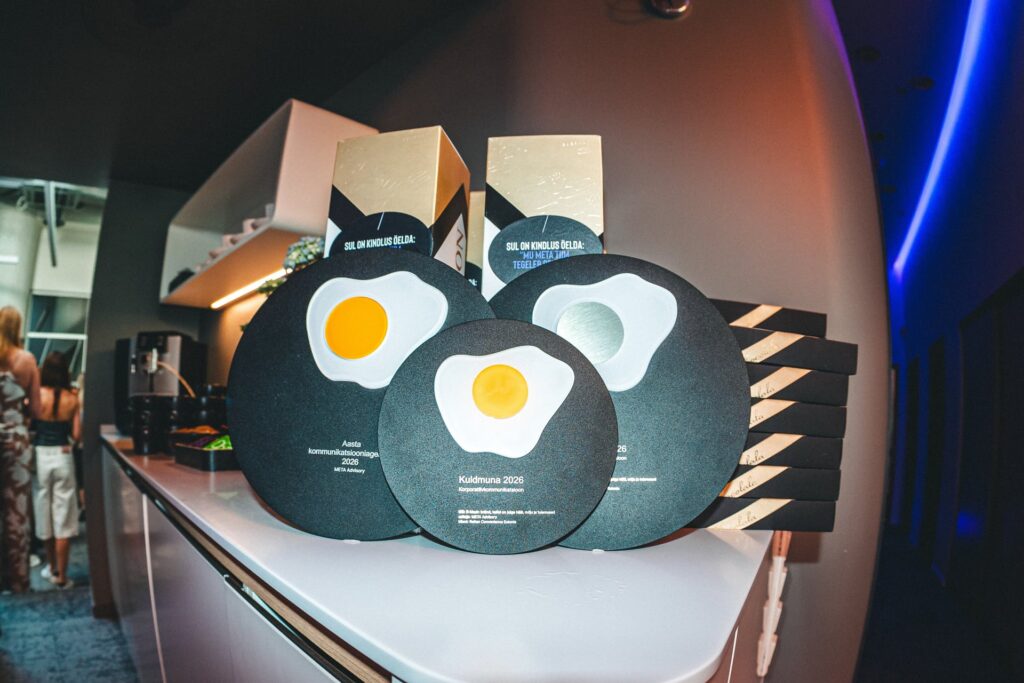
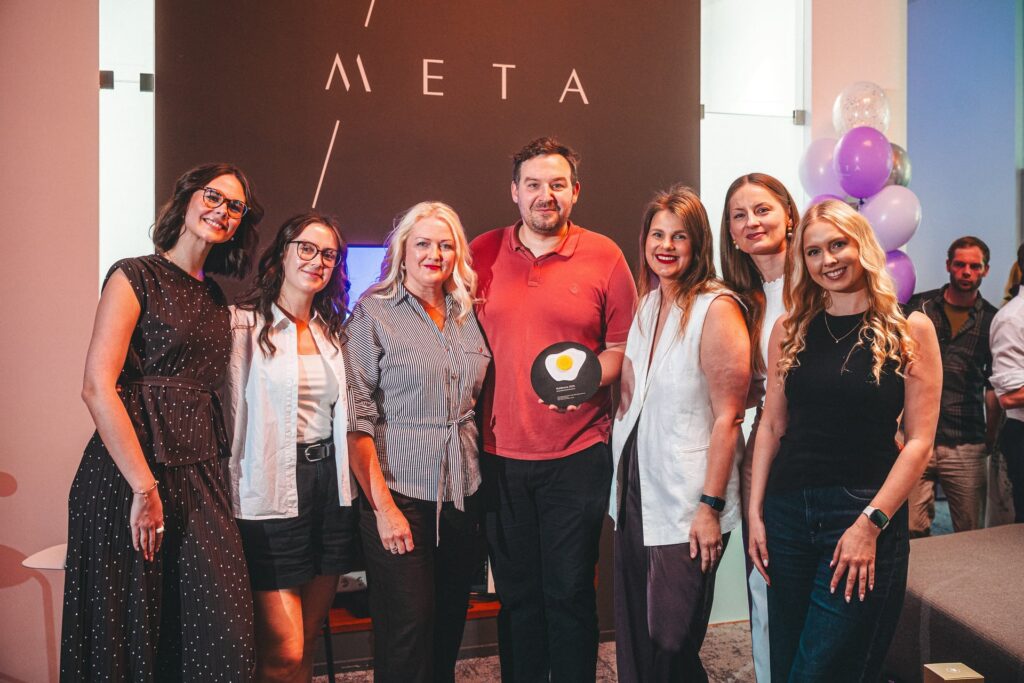
Meta Advisory is Estonia’s Communication Agency of the Year 2026
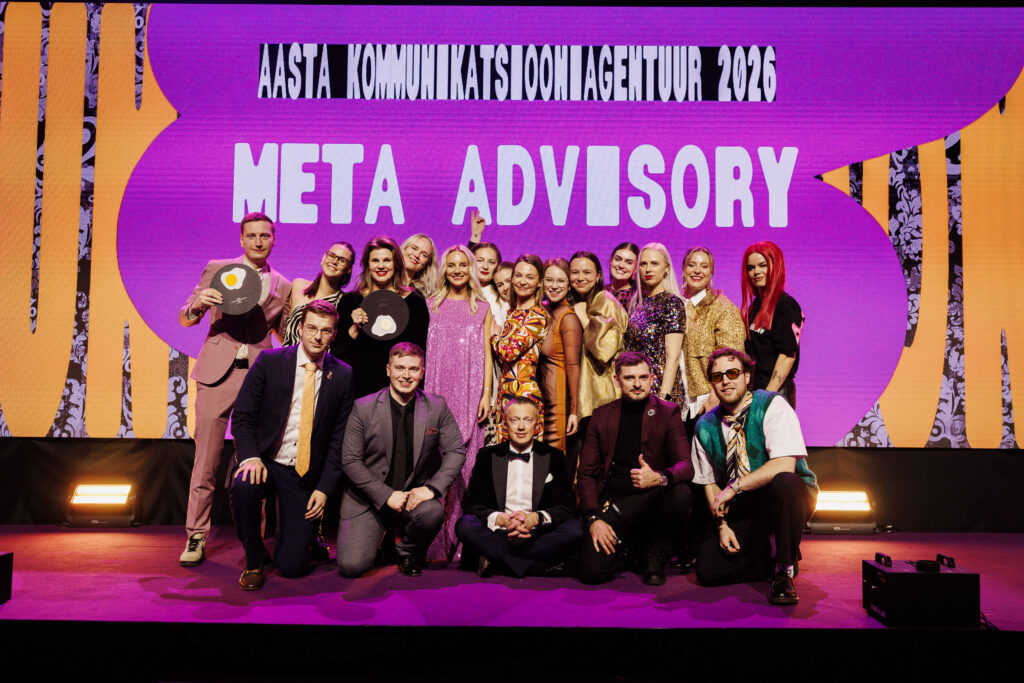
For the second year in a row, and for the fourth time in the past eight years.
Meta Advisory has been named Communications Agency of the Year for the fourth time. Our managing partner, Andreas Kaju, shared his thoughts with the Estonian Association of Marketing Communication Agencies about the past year, creativity in PR, and broader developments in the world. Here are a few excerpts from the interview.
Congratulations, you have once again been named Communications Agency of the Year! On social media, you said that last year was both the hardest and the most successful year yet. What exactly did you mean by “hardest”?
It was the hardest because the people at Meta worked harder than we ever have before. It is a very special feeling. I am 45, and I cannot remember the last time I felt like this.
Of course, people tend to remember more recent things better. The company’s early years probably involved much more work, and they were also psychologically harder because back then, there was less of a sense of security. I still remember that when I founded the company, I had no savings at all and lived off my partner’s civil servant salary.
I cannot say that last year we were operating at the very limit of our abilities. I do not want to leave the impression that our field is more difficult than it really is – this is work that is well within all of our capabilities. We are not da Vincis inventing the world, nor are we Medicis funding those who change it. Perhaps we are more like Machiavellis, advising the people who change the world.
Everyone wants hardworking employees. How do you find them?
We are never rude or dismissive, but we are direct. I no longer recruit everyone myself, but over the past 16 years, I have hired more than a hundred people. In the interviews I still take part in, I try to intimidate people a little.
I talk about the difficulties that come with this work. You have to manage many projects at once, and paradoxically, the less experience you have, the more projects you tend to handle.
The second thing is the stress that comes from the external environment. We are a relatively large company in our field, and there is quite a lot of action here. To be honest, it is a stressful job. Crises ripple through the company – when one colleague is dealing with a crisis, in a sense, all of us are.
The third thing is that we have our own values and red lines. There are some topics we simply do not work on, but even so, we have clients in a range of sectors, including some where there is a lot of tension and polarisation in society. An employee needs a strong moral backbone to cope with the ambiguity of working life.
The fourth important quality is diligence. Previous work experience and former employers help reveal that.
I also have a couple of entirely subjective indicators that help me identify diligence in younger people. One has studied or lived abroad, even briefly. That can include working as an au pair or doing some other kind of job abroad. It gives people life experience and makes them independent very quickly. Most young people do not have wealthy parents supporting them – they live on scholarships or work while studying.
The second is more controversial: people who have done sports from a young age. The third is the most subjective of all – young people from rural backgrounds. We have graduates here from top schools in central Tallinn and Tartu with excellent exam results, but hard work also shows in someone who has come from a small rural school that ranks who knows where in exam league tables, and still fought their way into a university abroad. That shows you want to achieve something. Those people have a monkey on their shoulder constantly telling them to keep going, keep going.
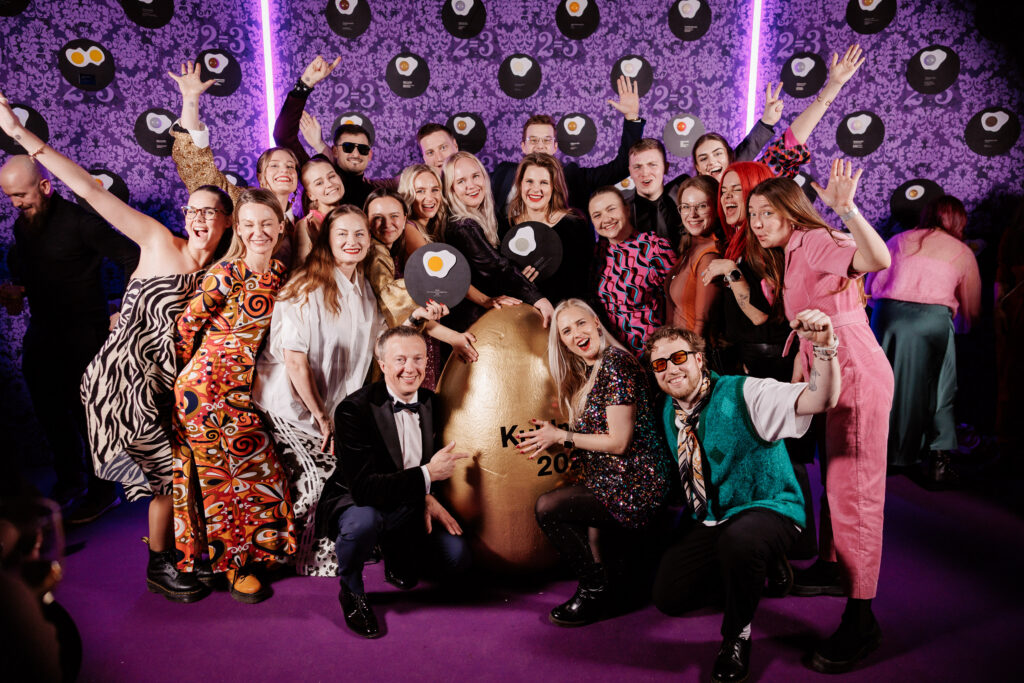
I understand that the Golden Egg, and creativity more broadly, has sparked debate among PR agencies. This year, many awards went to creative agencies and clients. In one social media post, you said that PR is above all a game of ROI. In your view, should the jury measure so-called real impact alongside creativity, and if so, how? And are PR agencies actually creative in the traditional sense – or do they need to be?
This can be discussed from many different angles. We are members of TULI, we take part in the Golden Egg, and we have always had the opportunity to contribute to the competition. I do not want to place myself outside it and start criticising the Golden Egg – that is not what I do. But to answer your question: it is inconceivable that awards should be handed out for work that means nothing at all to clients. That would be absurd. It is not TULI’s role to reward such things.
I am not saying that this has happened, but in order to answer, I need to explain my starting point. In communications, the Golden Egg should have a meaningful overlap between the client’s perspective and the jury’s criteria. We judge work based on best practice in communications as an art form, but there also needs to be common ground with clients, who care about results.
There is no point in presenting the jury with a campaign that was never actually shown anywhere, that had no stakes, and that produced no outcome. That would be absurd. It is a hypothetical argument – I am not claiming that such work is being rewarded today. After all, we ourselves have been chosen as Agency of the Year four times, I think.
Communication is, by its nature, a practical attempt to influence reality, perception, and behaviour. It is not something we do for our own entertainment, not an end in itself. That is why I clearly expect that, in communications, the best work is the work that has the greatest impact, that achieves the goals set for it or comes very close. Beyond that, there should also be a number of other criteria, and those are already well reflected in the Golden Egg jury rules.
This is not like ordering from Wolt or Bolt, where an algorithm gives you the best restaurant that exactly matches your preferences and the nearest courier to bring your food. Of course, there is always subjectivity, and it depends on the composition of the jury, their personal preferences, life experience, grudges, and intrigues. That is fine – it is all part of the game. In Estonia’s tiny pond, it can be amusing, but it is okay.
Even so, what matters most should still be what the client looks at. The client looks at effectiveness. Results are not always the same thing as ROI, but I believe that those who want to win awards need to be able to show what the client achieved through the campaign.
It is a completely different issue that the highest score this year went not to an agency, but to an in-house team. That may well happen again in the future. By all means, the best work that meets the criteria should be the work that gets awarded. We are going to have discussions about this with the heads of other agencies. People have approached me because they understood from my social media posts that I see it as a problem that agencies did not win many awards. No, that is not a problem at all.
We are judging the best communication work. If that work is done by an in-house team, I am very pleased. Especially since the team behind the year’s best communications team award (the President Kaljulaid Foundation – editor’s note) is led by our former and highly valued colleague, Cairit Rebane. Taken together with our alumni, we won both Agency of the Year and Team of the Year, so we are perfectly fine with that (laughs – editor’s note).
Agencies do not need to win if in-house teams are better. The Estonian market is so small that if we were competing for awards only against other agencies, the competition would be pretty thin.
There is a lot of anxiety in the world right now. What should Estonian or Estonia’s communication look like at this moment?
The challenge is to say that, perhaps objectively, things are not actually bad in Estonia. We could operate like all the other border countries that have learned to live with the fact that they are located in a historically challenging place. Even so, they go about their lives with confidence and courage. They always prepare for the worst, but they live each day as though there are 10,000 good years ahead. That is possible, but it requires enormous self-confidence.
That is what we currently lack. We live in a strange era, worried because of who our neighbour is. We have not found the key to self-confidence – how to believe in ourselves despite all the anxiety and stress. To believe in our education system and our economy. To think: out there is Mordor, but here things are in order. We have a plan, we act, we live our lives, and from time to time we practise for the worst. We do that so we can be sure we know what to do if the worst should happen.
We have yet to find that self-confidence, and I believe professionals across our entire field could help build it in the years ahead. Communication can also be ironic and sarcastic, but I feel that our society needs communication that is self-aware, realistic, and looks to the future with optimism – not communication marked by resignation or hopelessness.
Read the full interview on the TULI portal.





Photos by Marek Metslaid.